Sunstone, Moonstone, Labradorite, Amazonite
Feldspar Gemstones: Sunstone, Moonstone, Labradorite & Amazonite
Feldspar is one of the most abundant mineral groups on Earth, accounting for approximately 60% of the planet’s continental crust. This large family of aluminosilicate minerals is broadly divided into two major groups: plagioclase feldspar, a sodium–calcium series, and alkali feldspar, which includes potassium-rich minerals such as orthoclase and microcline.
Although feldspar minerals are common in the geological world, several varieties are valued as gemstones for their distinctive colors, optical phenomena, and natural beauty. Among the most recognized feldspar gemstones are Sunstone, Moonstone, Labradorite, and Amazonite.
Feldspar gemstones are particularly appreciated for the remarkable ways in which they interact with light:
-
Aventurescence — a shimmering effect created by light reflecting from minute reflective inclusions, characteristic of Sunstone.
-
Adularescence — a soft, floating glow that appears beneath the surface of a gemstone, most famously associated with Moonstone.
-
Labradorescence — an iridescent play of blue, green, gold, and other colors produced by light interacting with the internal structure of Labradorite.
-
Distinctive body color — gemstones such as Amazonite are valued primarily for their attractive turquoise-green color rather than for an optical phenomenon.
With their combination of color, character, and optical effects, feldspar gemstones have long been used in ornamental objects and jewelry. Today, they are particularly popular in artisanal and contemporary jewelry, where their natural variations and distinctive appearances give each stone an individual character.
1. Sunstone
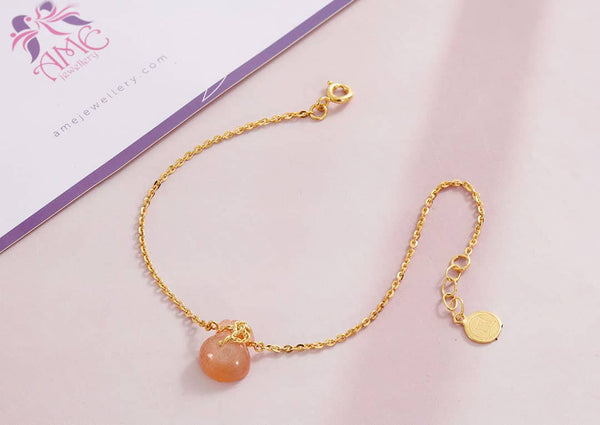
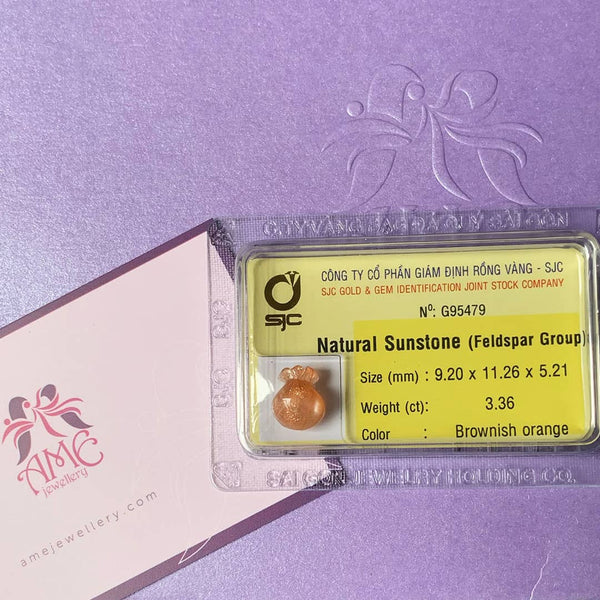
Sunstone is a feldspar gemstone best known for its characteristic aventurescence—a glittering effect created when light reflects from tiny plate-like inclusions within the stone. Depending on its mineral composition and inclusions, Sunstone may belong to the plagioclase or alkali feldspar series.
Its body colors range from pale yellow and champagne to orange, pink, red, and green. Some stones display a subtle shimmer, while exceptional examples show vivid, well-oriented inclusions that create a striking metallic sparkle.
History & Cultural Significance
Sunstone has been admired for centuries because of its warm color and sun-like appearance. Its golden and reddish tones have naturally inspired associations with sunlight, vitality, warmth, and abundance across different cultures.
In modern jewelry, Sunstone is particularly appreciated for its natural aventurescence, which gives the gemstone a lively appearance that changes with the direction of light.
Gemstone Factors
-
Mineral Group: Feldspar
-
Variety: Sunstone
-
Composition: Varies according to feldspar species; gem-quality Sunstone may occur in both plagioclase and alkali feldspar
-
Color: Yellow, champagne, orange, pink, red, and green
-
Optical Phenomenon: Aventurescence
-
Mohs Hardness: 6–6.5
-
Luster: Vitreous to pearly
-
Transparency: Transparent to opaque
The quality and orientation of reflective inclusions have a major influence on the appearance and desirability of Sunstone. Copper-bearing Oregon Sunstone is particularly notable for its range of colors and aventurescence.
Important Sources
-
United States: Oregon is renowned for copper-bearing Sunstone in yellow, orange, red, and green.
-
India: Produces a range of Sunstone, including more affordable material.
-
Norway: Known historically for oligoclase Sunstone.
-
Other sources: Gem-quality feldspar with aventurescence is also found in several other localities.
2. Moonstone
Moonstone is one of the best-known feldspar gemstones and is valued for its distinctive adularescence—a soft, billowy glow that appears to float beneath the surface of the stone.
Moonstone can occur in different feldspar compositions, including orthoclase and related alkali feldspar varieties, as well as certain plagioclase feldspars historically marketed under the broader Moonstone name. Its body colors include white, gray, cream, peach, and brown, while the most sought-after material may display a strong blue or bluish-white adularescent sheen.
History & Cultural Significance
Moonstone has inspired associations with the moon, femininity, intuition, and romance for centuries. Ancient traditions in India regarded Moonstone as a sacred gemstone, while its luminous appearance later made it particularly attractive to European jewelers.
During the Art Nouveau period, Moonstone became especially popular among designers who appreciated its soft glow and organic character. Its ethereal appearance continues to make it a favorite for romantic and contemporary jewelry.
Moonstone is also traditionally associated with June as a birthstone.
Gemstone Factors
-
Mineral Group: Feldspar
-
Variety: Moonstone
-
Composition: Commonly orthoclase or related alkali feldspar; some material is associated with plagioclase feldspar
-
Color: White, gray, cream, peach, brown, and occasionally other hues
-
Optical Phenomenon: Adularescence
-
Mohs Hardness: 6–6.5
-
Luster: Vitreous to pearly
-
Transparency: Transparent to translucent
The most desirable Moonstone typically combines good transparency with a strong, well-centered adularescent glow. Blue sheen on a relatively clear body is particularly prized.
Important Sources
-
Sri Lanka: Historically renowned for fine Moonstone, including material with attractive blue adularescence.
-
India: An important source of white, gray, peach, and other Moonstone varieties.
-
Madagascar: Produces attractive gem-quality material.
-
Myanmar: Known for Moonstone and other feldspar gemstones.
-
Other sources: Moonstone has also been found in several locations worldwide.
3. Labradorite
Labradorite is a calcium-rich member of the plagioclase feldspar series, renowned for its dramatic labradorescence—a vivid play of color that can appear blue, green, yellow, orange, or combinations of these colors.
At first glance, Labradorite is often gray, brownish-gray, or dark gray. When viewed from the appropriate angle, however, flashes of intense color can emerge from within the stone, creating one of the most distinctive visual effects in the feldspar family.
History & Cultural Significance
Labradorite was first described from Labrador, Canada, where it became known to European mineralogists in the late 18th century. Its remarkable color flashes quickly attracted attention and contributed to its reputation as a mysterious and visually captivating stone.
Labradorite later became popular in decorative objects and jewelry. Today, it is especially appreciated by designers who want a gemstone with a dramatic, natural play of color rather than a perfectly uniform appearance.
Gemstone Factors
-
Mineral Group: Feldspar
-
Variety: Labradorite
-
Composition: (Ca,Na)(Al,Si)₄O₈
-
Color: Usually gray to dark gray, with blue, green, gold, yellow, or multicolor flashes
-
Optical Phenomenon: Labradorescence
-
Mohs Hardness: 6–6.5
-
Luster: Vitreous to pearly
-
Transparency: Transparent to opaque
The value and visual appeal of Labradorite depend heavily on the strength, distribution, and color of its labradorescence. Stones displaying broad, intense, and attractive flashes are particularly desirable.
The term Spectrolite is commonly associated with a variety of Labradorite from Finland that can display exceptionally vivid, often multicolored, labradorescence.
Important Sources
-
Canada: Labradorite was originally identified in Labrador and remains an important source.
-
Finland: Famous for Spectrolite with intense multicolored labradorescence.
-
Madagascar: Produces attractive Labradorite in a range of sizes and colors.
-
Other sources: Labradorite is also found in several locations, including Australia, Mexico, and the United States.
4. Amazonite
Amazonite is a green to blue-green variety of microcline, an alkali feldspar. Unlike Sunstone, Moonstone, and Labradorite, Amazonite is not primarily valued for an optical phenomenon. Its appeal lies in its distinctive turquoise-green to blue-green body color, often accompanied by attractive white or pale streaks.
The color of Amazonite is commonly associated with trace amounts of lead and water within its crystal structure. Its opaque to translucent appearance gives it a distinctive, calm, and natural character that works particularly well in contemporary and artisanal jewelry.
History & Cultural Significance
The name Amazonite was inspired by the Amazon River, although the Amazon basin is not considered a significant source of the gemstone. The name may have been applied because of its resemblance to the green stones traditionally associated with the region.
Green and blue-green stones have been used ornamentally since antiquity, and Amazonite continues this long tradition of using naturally colored minerals for jewelry and decorative objects.
Gemstone Factors
-
Mineral Group: Feldspar
-
Variety: Amazonite
-
Mineral Species: Microcline
-
Composition: KAlSi₃O₈
-
Color: Green, blue-green, turquoise, and occasionally yellowish green
-
Optical Phenomenon: None characteristic
-
Mohs Hardness: 6–6.5
-
Luster: Vitreous to pearly
-
Transparency: Translucent to opaque
Fine Amazonite is generally appreciated for its attractive, saturated blue-green or turquoise-green color and pleasing patterns. Because it has pronounced cleavage, it should be handled with reasonable care in jewelry.
Important Sources
-
Russia: Historically important deposits occur in the Ural region.
-
United States: Colorado is particularly well known for attractive Amazonite.
-
Brazil: An important source of commercial and gem-quality material.
-
Madagascar: Produces Amazonite in attractive colors and patterns.
-
Other sources: Material is also found in several other localities worldwide.
Feldspar Gemstones in Jewelry
Feldspar gemstones offer a distinctive combination of color, natural character, and optical beauty. Their relatively moderate hardness of 6–6.5 on the Mohs scale, together with their pronounced cleavage, means they require more care than harder gemstones such as sapphire or diamond.
For this reason, feldspar gemstones are particularly well suited to pendants, earrings, brooches, and carefully designed rings and bracelets where the stone can be adequately protected.
Jewelry Care
To preserve the beauty of feldspar gemstones:
-
Avoid sharp impacts and activities that may expose the stone to excessive force.
-
Store each piece separately to prevent scratches from harder gemstones.
-
Clean gently with a soft cloth and lukewarm water.
-
Avoid ultrasonic and steam cleaners.
-
Remove feldspar jewelry before strenuous activities, sports, or situations where the gemstone may be struck.
The natural variations found in feldspar are part of their appeal. From the shimmering aventurescence of Sunstone, to the moonlit glow of Moonstone, the dramatic flashes of Labradorite, and the serene turquoise-green of Amazonite, each variety offers a different expression of this remarkably diverse mineral family.