
What Makes One Jade Worth Hundreds of Dollars While Another Is Worth Millions?
The beauty of jade extends far beyond its appearance. For centuries, collectors, scholars, and connoisseurs have admired fine jade not only for its cultural significance but also for the remarkable qualities that distinguish an exceptional stone from an ordinary one.
When evaluating jade, experts consider a combination of factors, including color, transparency, texture, craftsmanship, and size. No single characteristic determines value on its own; rather, the finest jade achieves a harmonious balance among all these qualities.
1. Color — The Soul of Jade
Among all quality factors, color is the most important.
Although jade is often associated with green, natural jade occurs in a remarkable range of colors, including white, lavender, yellow, orange, red, black, and brown. Each hue possesses its own beauty and appeal.
The most valuable color is Imperial Green Jadeite, a vivid and richly saturated green often compared to the finest emeralds. Highly translucent Imperial Green jadeite is among the rarest gemstones in the world.
Other highly prized colors include:
- Lavender Jadeite – admired for its elegance and rarity.
- Icy White Jadeite – valued for its purity and translucency.
- Apple Green Jadeite – bright and vibrant.
- Moss-in-Snow Jadeite – translucent white jade accented by natural green patterns.
In general, jade with vivid, evenly distributed color commands the highest value.

Jadeite jade comes in a variety of colors, and Imperial jade is the most prized and expensive. GIA
2. Transparency — The Light Within
Transparency is one of the defining characteristics of fine jade.
Unlike diamonds, jade does not sparkle through brilliance. Instead, its beauty comes from the way light gently penetrates beneath the surface, creating a soft inner glow.
The most valuable jadeite displays a translucent appearance often described as luminous or glowing.
Transparency is commonly classified as:
- Opaque
- Slightly translucent
- Moderately translucent
- Highly translucent
At the highest level, exceptionally transparent jadeite is often referred to as Glass Jade, prized for its remarkable clarity and radiance.
When color and transparency occur together in a single stone, value increases significantly.
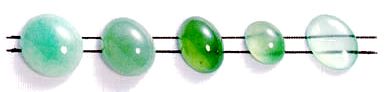
Jadeite is almost always opaque. It's quite rare to find a piece that is even slightly translucent. In the photo, the first three are opaque, the next one is somewhat transparent, and the last one is the most transparent of the lot.
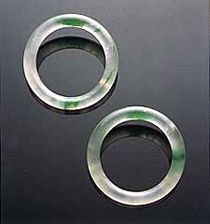
This pair of jadeite bracelets is extremely rare. The pair is nearly colorless and features emerald green spots. (Images courtesy of Christie's Hong Kong and Tino Hammid).
3. Texture — The Foundation of Fine Jade
Texture refers to the structure and arrangement of the microscopic crystals within jade.
Fine-textured jade appears smooth, compact, and refined. It reflects light evenly and often exhibits a rich, silky luster.
Coarser textures may appear grainy or uneven, reducing the stone's visual appeal.
Collectors often describe exceptional jade as possessing:
- Fine grain
- Compact structure
- Smooth surface
- Silky luster
Texture is particularly important because it influences both transparency and durability.
4. Inclusions and Fractures
Like many natural gemstones, jade forms within the earth under immense geological pressure. As a result, inclusions and natural characteristics are common.
Minor inclusions may have little effect on beauty or durability. However, large fractures can reduce both the value and structural integrity of the stone.
Particular attention is paid to jade bangles, which are carved from a single piece of jade and are more susceptible to damage if significant fractures are present.
In general:
- Clean, uniform jade is more valuable.
- Visible fractures reduce value.
- Well-preserved material commands a premium.
The finest jade combines natural beauty with structural integrity.
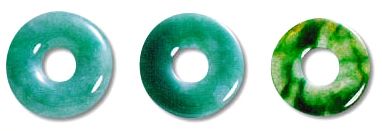
Due to its polymineralic composition and the presence of various impurities, jadeite typically exhibits a variegated coloration. The image illustrates a progressive increase in color uniformity as one's gaze moves from right to left.
5. Craftsmanship — Revealing the Beauty of Jade
A beautiful piece of jade begins with exceptional material, but craftsmanship ultimately reveals its full potential.
Because jade is carved rather than faceted, the skill of the artisan plays a crucial role in maximizing the stone's beauty.
Traditional jade forms include:
Cabochons
The most prized cabochons display balanced proportions, strong color, excellent transparency, and smooth symmetry.
Beads
Fine jade bead necklaces require careful matching of color, texture, transparency, and size throughout the strand.
Bangles
Among the most iconic forms of jade jewelry, bangles are carved from a single piece of jade. Because substantial material is lost during carving, fine jade bangles are often among the most valuable jade creations.
Carvings and Symbolic Forms
From Guanyin and Maitreya Buddha to the ancient Bi disc, jade carvings combine artistic craftsmanship with cultural meaning. Precision, balance, and the quality of the material all contribute to their value.
6. Size and Rarity
When all other quality factors are equal, larger jade pieces are generally more valuable.
Large sections of fine-quality jade are exceptionally rare in nature. As a result, substantial cabochons, bangles, and bead necklaces often command significantly higher prices than smaller pieces.
In the case of Imperial Green jadeite, even small differences in size can lead to dramatic differences in value.
The Harmony of Quality
The finest jade is never judged by a single characteristic alone.
Color, transparency, texture, craftsmanship, and size work together to create beauty and value. A truly exceptional piece of jade achieves harmony among all these qualities, allowing its natural character to shine.
Whether fashioned into a bangle, a cabochon ring, a strand of beads, or an intricately carved pendant, fine jade remains one of the world's most treasured gemstones—celebrated for its rarity, artistry, and enduring cultural significance.


