

Kokichi Mikimoto: The King of Pearls

On July 11, 1893, the first semi-spherical cultured pearl was created using Kokichi Mikimoto's techniques. He later refined this method to produce a perfectly round pearl from the Akoya pearl oyster in the Sea of Japan in 1905. His pearl-culturing technique was officially patented in 1916, and he was one of Japan's greatest inventors. Even the legendary American inventor, Thomas Edison, expressed deep admiration for these cultured pearls.
"I would like to adorn the necks of all the women in the world with pearls." — Kokichi Mikimoto
 Kokichi Mikimoto - The King of Pearl
Kokichi Mikimoto: The King of Pearls
Kokichi Mikimoto was born on January 25, 1858, in Toba, a small town on Japan's Shima Peninsula. While natural pearls were Toba's most famous local product, they were becoming increasingly scarce due to overharvesting. This scarcity inspired Mikimoto to find a way to manually insert a nucleus into an oyster to replicate the natural pearl-forming process.
- Natural Pearls: Formed when a foreign object (like a grain of sand) enters an oyster or freshwater mussel. To protect itself, the mollusk secretes layers of nacre (mother-of-pearl) around the irritant, eventually forming a pearl.
- Cultured Pearls: Humans directly implant a nucleus into the oyster. The oysters are then placed in wire cages and submerged in the sea. Over time, the oyster coats the nucleus in nacre. Finally, the oysters are harvested to retrieve the pearls.

The process of culturing pearls
A Journey of Failure and Triumph
Mikimoto’s dream began in 1888. His early years were plagued by technical failures, trial-and-error methods, and natural disasters like "red tide" (algal blooms) that wiped out his oyster populations. However, on July 11, 1893, he finally succeeded in culturing his first pearl.
In 1899, he opened the Mikimoto Pearl Store in Tokyo’s Ginza shopping district, laying the foundation for Japan's modern jewelry industry. By 1905, he achieved the "holy grail" of pearl culturing: the first perfectly round pearl.


Expanding the Empire
It took nearly 30 years (into the 1920s) for Mikimoto to achieve global fame. His innovations expanded rapidly:
-
1914: Cultured Black South Sea pearls on Ishigaki Island, Okinawa.
-
1924: Successfully cultured Freshwater Pearls in Lake Biwa, where a single mussel could produce up to 20 pearls.
-
Global Expansion: He sent researchers to Palau and even explored the Bay of Bengal in India to find ideal culturing grounds.

Mikimoto Kokichi and his Mikimoto Pearls storefronts in Osaka and on the Ginza (Tokyo), c. 1950.

Cherry Blossom brooch with pearls was cultured by Mikimoto Kokichi in the Japan Times in 1906: "Genuine fine oriental pearls".
The "Pearl War" and Thomas Edison
In 1919, when Mikimoto exhibited his round cultured pearls in London, they were sold at 25% less than natural pearls. Western jewelers, fearing for their business, labeled them "fakes" and attempted to ban their sale. However, British and French scientists eventually confirmed that cultured pearls were biologically identical to natural ones, further boosting Mikimoto's reputation.
In 1927, during a visit to the United States, Mikimoto met Thomas Edison. Upon examining the pearls, Edison remarked:
"This is not a cultured pearl, it is a real pearl. There are two things I cannot produce in my laboratory: diamonds and pearls. Your success is a wonder of biology and a miracle for humanity."
Mikimoto humbly replied: "If you are the Moon in the sky of invention, I hope to be but a single Star in the Milky Way."
"Romance Of Pearl Culture In Japan 1922"
The Legacy of the AMA and Mikimoto
Mikimoto's work also preserved the tradition of the AMA—the legendary Japanese female pearl divers. The AMA would dive to collect oysters for the farm and return them to the seabed after the nucleus was implanted. Mikimoto even designed the iconic white diving outfits they are known for today.

The "Boss’s Necklace"
Today, the Mikimoto Pearl Museum on "Mikimoto Pearl Island" houses the "Taisho-ren" (also known as the Boss’s Necklace). It consists of 49 large, exceptionally lustrous pearls, with a 14mm center pearl. Mikimoto spent 10 years personally selecting these pearls, and the necklace remains the gold standard for all classic Mikimoto designs.
Now at the age of 90, Mikimoto once said: "The most important things in life are knowledge and luck... If a person lives a long life, they are truly successful."
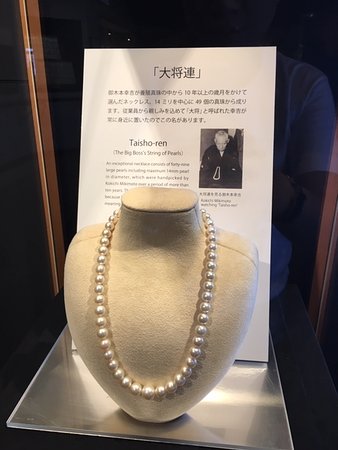
Mikimoto Taisho-ren / Boss’s Necklace
Source: Mikimoto, Mikimoto Pearl Museum
Leave a comment